


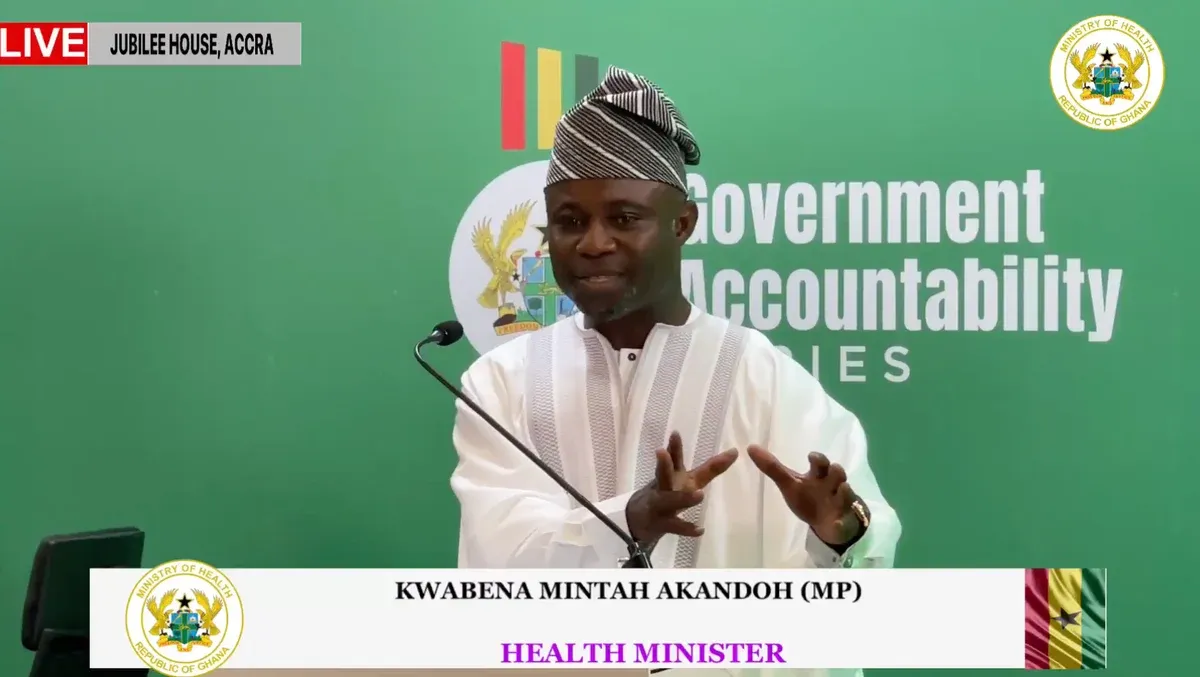
Minister for Health Kwabena Mintah Akandoh, says the Free Primary Health Care Programme will begin in 150 underserved Districts and over the next two months, Ghanaians will begin to see this transformation in action.
Health equipment will be distributed to all 150 districts that will be part of the first phase of implementation, he said.
Community sensitisation will be done through town halls and engagements.
Trained volunteers will be deployed to support community health workforce.
He said “Over 350 container-based service delivery points in high-traffic areas such as markets and lorry parks.
“Health workers and volunteers will not only be waiting at facilities—they will be in your homes, schools, churches, and workplaces—screening, educating, and supporting you to stay healthy.”
The Minister for Health, Kwabena Akandoh, announced this at a press engagement on Monday, April 13, on the policy, emphasising that the initiative is designed to eliminate financial barriers and promote early access to healthcare across the country.
“It is important to emphasise that there will be no cost for the preventive and promotive as well as curative services within the Free Primary Health Care service package. The only thing you need is to show a valid National ID,” he stated.
AIListenQuizAskBackground
The policy forms part of Ghana’s broader effort to achieve Universal Health Coverage (UHC), ensuring that all citizens can access essential healthcare services without financial hardship. Currently, Ghana’s UHC service coverage stands at about 56 per cent, with a target of 80 per cent by 2030.
Mr Akandoh acknowledged that despite existing interventions such as the National Health Insurance Scheme (NHIS) and the Community-based Health Planning and Services (CHPS) programme, many Ghanaians still face out-of-pocket payments, which often delay timely access to care.
The new policy seeks to address this by guaranteeing free access to a defined package of essential services at the primary healthcare level, including CHPS compounds, health centres, and polyclinics nationwide.
Under the programme, patients will receive routine screenings for conditions such as hypertension, diabetes, and certain cancers, as well as maternal and child health services, immunisation, and treatment for common illnesses like malaria and respiratory infections.
Source:3news.com
