


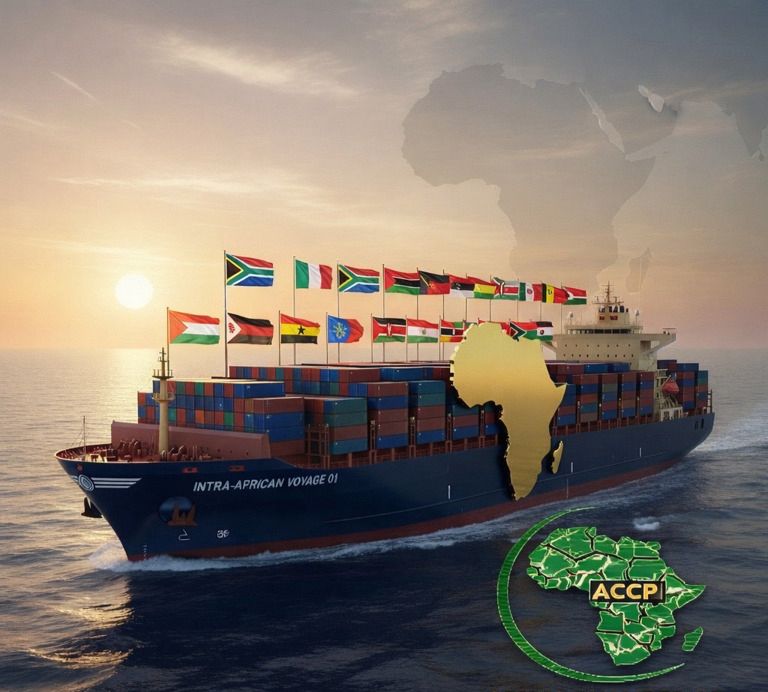
The African Chamber of Content Producers (ACCP) has said escalating global trade tensions must serve as a decisive catalyst for Africa to fully realise its own continental market.
In a press release copied to the Ghana News Agency, the Chamber urged African heads of state to accelerate the full implementation of the African Continental Free Trade Area (AfCFTA) to build economic self-reliance and shield the continent from external disruptions.
“The sight of major powers weaponizing trade routes and logistics is a stark wake-up call for our continent,” said Dwomoh-Doyen Benjamin, President of the ACCP.
“Africa’s continued heavy reliance on goods and services from other regions leaves us profoundly vulnerable to crises not of our making. The time for cautious deliberation is over; the time for decisive action to build and trade within our own borders is now,” he added.
The Chamber noted that despite the landmark AfCFTA agreement, practical barriers continued to stifle progress.
“A core issue remains low awareness and utilization among the very businesses meant to benefit. For 11 major African economies, intra-African trade accounted for just 11.8 per cent of their total trade in 2023, a share that has declined since the agreement came into force. The ACCP insists the African Union must launch a robust, continent-wide advocacy campaign to demystify the AfCFTA’s rules and opportunities for entrepreneurs and corporations alike,” the statement said.
The Chamber’s call comes amid growing frustration within the private sector. The Association of Ghana Industries (AGI) has warned that Ghanaian businesses cannot afford to wait indefinitely for the full benefits of the AfCFTA to materialise.
Speaking after the AGI’s national council retreat in Accra on February 13, 2026, AGI President, Kofi Nsiah-Poku, said exporters were increasingly impatient.
“We cannot wait forever; our products are ready, and with direct collaboration between governments, we can begin exporting immediately rather than being delayed by prolonged formalities,” he stated.
He highlighted what he described as a paradox, noting that exporting to Europe or Asia was sometimes more predictable than trading with neighbouring countries such as Togo and Côte d’Ivoire due to excessive paperwork, inconsistent border procedures and logistical bottlenecks.
According to the ACCP, fewer than ten countries have fully operationalised domestic AfCFTA rules, resulting in a patchwork of regulations. It also pointed to a trade finance gap estimated between 81 and 120 billion dollars annually, alongside infrastructure deficits that make intra-African shipping costly and inefficient.
As part of its proposed solutions, the Chamber called for a continental “Build It Here” initiative to unite African and African-Diaspora engineers and businesses to develop rail linkages and advanced engineering centres.
It cited ongoing aerospace and manufacturing efforts such as the Skyleader 600 aircraft being produced in Tanzania and Kiira Coaches and buses manufactured in Uganda as examples of what could be achieved with coordinated continental investment.
To address currency and payment barriers, the ACCP advocated accelerated adoption of a unified African digital currency, warning that continued reliance on foreign currency systems risked undermining monetary sovereignty.
While commending the Pan-African Payment and Settlement System (PAPSS) as a critical intervention, the Chamber stressed the need for widespread education to build trust in new payment platforms.
“We need more projects that get Africans talking to each other, creating together, and seeing their future as a shared one,” Nana Dwomoh-Doyen stated.
He said that philosophy inspired the Chamber’s co-founding of the Africa Monologue Challenge with MK Casting and the National Film Authority of Ghana.
“Giving a single, powerful voice, a monologue to Africa is our contribution to building the cultural understanding that must underpin economic integration,” he explained.
The initiative has formed a strategic partnership with the Africa Prosperity Network, with the Uganda Communications Commission serving as Executive Producers in the production of its first Pan-African feature film in Uganda.
Ambassador David Adofo, Head of Research and Development at the ACCP, said external shocks such as sanctions between superpowers and disruptions in global trade routes would have limited impact if Africa invested in research and human capital.
“Imagine cocoa from Ghana and Ivory Coast combined with milk from Uganda, and machinery from Ethiopia to produce chocolate that is one hundred percent African in origin,” he said.
Ambassador Nana Nketia, a board member of the ACCP, cited the example of Quality Chemicals Industrial Limited in Uganda, a wholly African-owned pharmaceutical company producing essential medicines, including antiretroviral drugs, as proof of the continent’s capacity for self-reliance.
The ACCP concluded that achieving “local content sovereignty” in goods, services and narrative was an urgent strategic imperative for Africa’s economic security and global standing.
Source: GNA
