


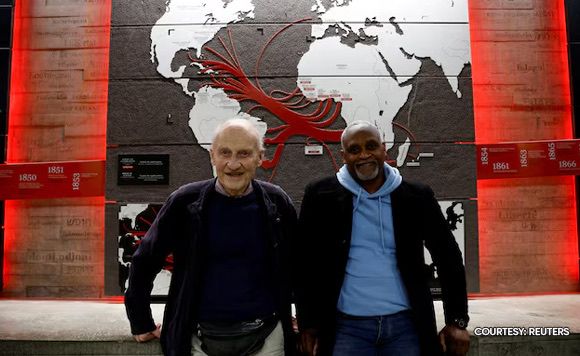
Nantes, France — In a rare and deeply personal act, an 86-year-old Frenchman has become the first person in France to publicly apologise for his family’s historical involvement in the transatlantic slave trade.
Pierre Guillon de Prince made the apology during a gathering in Nantes, once France’s largest slave-trading port. His ancestors were shipowners who, according to historical records, transported approximately 4,500 enslaved Africans across the Atlantic and owned plantations in the Caribbean.
The moment came just ahead of the inauguration of an 18-metre replica ship mast in the city — a symbolic structure intended to prompt reflection on Nantes’ maritime past and its entanglement with slavery.
“Faced with the rise of racism in our society, I felt a responsibility not to let this past be erased,” Guillon de Prince said. He added that he hopes to pass the truth of his family’s history on to his grandchildren.
Standing beside him was Dieudonné Boutrin, a descendant of enslaved people from Martinique. The two men collaborate at Coque Nomade-Fraternité, a human rights association in Nantes dedicated to remembrance of slavery and reparations.
Boutrin described the apology as a “courageous act,” noting that many families with ties to slave traders remain silent out of fear of reopening old wounds and provoking anger.
“Many families of descendants of slave traders don’t dare speak out for fear of reopening old wounds and anger,” he said.
A Personal Reckoning in a Nation Still Grappling with Its Past
While France formally recognised transatlantic slavery as a crime against humanity in 2001, the French state has never issued an official apology for its role in the trade, which saw an estimated 1.3 million Africans trafficked by French ships.
Guillon de Prince’s gesture is therefore significant as a private act of accountability amid what many see as a broader national silence on the issue.
The replica ship mast was described by both men as a “beacon of humanity” — a reminder of past suffering and a call for dialogue and understanding.
Part of a Growing Global Conversation
The event in Nantes mirrors a wider international reckoning with the legacy of the transatlantic slave trade, which operated from the 15th to the 19th century and forcibly displaced about 12.5 million Africans.
In recent years, some families in Britain and other countries have issued similar personal apologies. Guillon de Prince expressed hope that his action would encourage others — including governments — to pursue acknowledgment and reparative justice.
The issue remains highly divisive. A recent United Nations General Assembly resolution labelled the trafficking of enslaved Africans as “the gravest crime against humanity” and called for reparations as a concrete step toward remedying historical wrongs. It also urged the return of cultural artefacts taken during the colonial period. The resolution passed with 123 votes in favour, three against, and 53 abstentions, with France among those that abstained.
Advocates argue that centuries of exploitation continue to fuel global inequalities, while critics question the practicality and fairness of calculating compensation across generations.For Pierre Guillon de Prince, the focus is simpler: taking responsibility for the past rather than allowing it to be forgotten.
His apology may not bring full closure to one of history’s darkest chapters, but it reopens a conversation that many would prefer to leave closed — and places a deeply personal act at the heart of a global debate still searching for resolution.
