


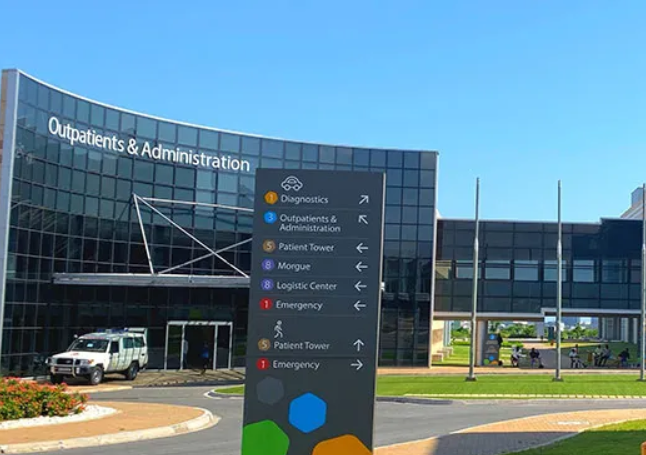
At the reception of University Hospital, Legon, the response was casual, almost dismissive.
“You can take it to 37 [Hospital],” a staff member said when we presented our National Health Insurance Scheme (NHIS) card.
No explanation. No sympathy. Just a referral to 37 Military Hospital, one of the few public facilities in Accra where the national insurance is reliably accepted. That moment was not an anomaly. Over weeks of visits across Accra, The Fourth Estate uncovered a disturbing pattern: some of the modern hospitals in Ghana, built or sustained with public money, tax waivers, state loans, or pension funds, have shut their doors to NHIS patients.
For millions of Ghanaians, this means their taxes and contributions are underwriting hospitals they cannot afford to enter with the one card that was meant to guarantee them access.
The gatekeepers at the door
At University Hospital, there was no NHIS signage. A man behind the counter barely looked up from his phone when asked, “Do you accept NHIS here?”
“No, we don’t,” he told The Fourth Estate. He reeled off private insurance options instead. Without NHIS, consultation and registration cost GHS 120 at the facility.
Across the road is the University of Ghana Medical Centre (UGMC). Here, the story was the same. The receptionist quoted GHS 200 for consultation. Cash or private insurance only.
At the Trust General Hospital in Osu, NHIS was also not accepted. Consultation alone costs GHS 200. Meanwhile, the International Maritime Hospital (IMaH) in Tema – owned by the Ghana Ports and Harbours Authority – charged GHS 100 for registration even while accepting NHIS for consultation.
At the Bank Hospital, the bill was even higher: GHS355 for registration and consultation.
The contrast with facilities like Ridge Hospital or 37 Military Hospital could not be sharper. At Ridge, NHIS covers consultation, medicines, and many lab tests. At 37, NHIS patients are greeted by a dedicated office. A new patient card costs GHS 80, with NHIS covering most of it. For ordinary citizens, the difference is life-defining: hospitals built with state funds, but two very different realities.
Following the money
The contradiction deepens once you trace the money behind these hospitals. UGMC, built with a US$217 million loan from Israel, later expanded with a €40.5 million loan, and cushioned by over US$20 million in tax exemptions. Parliament approved these waivers, covering import duties, VAT, inspection fees, and withholding taxes. The Auditor-General’s 2024 audit even praised UGMC as a rare example of effective equipment procurement.
Yet, NHIS cardholders are turned away. Head of Public Relations and Client Services, Barbara Owusu-Hemeng, said it works with 15 private insurers, with around 60% of patients paying out of pocket. Emergency patients benefit from a “Treat Before Payment” policy.
“The centre has opened discussions with NHIA [National Health Insurance Authority] about coverage, but it is not yet fully integrated,” she told The Fourth Estate.
“The health facility also runs a customer segment pricing model,” she said, adding that it charges premium rates for specialist care and 24-hour air conditioning.
The University Hospital, Legon, began as a Ministry of Health-supported clinic but shifted into cash-and-carry policies in the 1980s. Today, despite decades of public support, it remains closed to NHIS users. Our Right to Information (RTI) requests to the Legal Affairs Directorate about its financing were met with delays. An interview request to the University of Ghana’s Public Affairs Directorate was redirected to the Health Services Director, but we never received a response. Officials later said archived construction records exist, but retrieval would take time.
The Bank Hospital started as a Bank of Ghana clinic in 1988, but an €80 million modern facility was opened in 2021 as a commercial entity under private management. NHIS is not accepted, and management, including the Bank of Ghana, did not respond to multiple interview requests despite acknowledging our RTI application.
The Trust Hospital, built with SSNIT funds and sustained by pensioners’ contributions, is now valued at GHS 68.5 million. Over the years, it has grown into a network of five hospitals and five clinics.
The General Manager, Investment and Development at SSNIT, Patience Akua Owusu, told The Fourth Estate that some of the satellite clinics accept NHIS (for consultation only), but its flagship Osu hospital excludes cardholders. SSNIT declined to release internal board deliberations requested under RTI.
IMaH and other facilities built by public agencies are also among the modern hospitals that either limit NHIS use or accept it only in part.
Every cedi of tax waivers, public loans, and pension funds invested into these hospitals was meant to build health infrastructure for Ghanaians. Yet the very system designed to guarantee access – the NHIS – stops at their doors. The NHIS received a major funding boost of GHS10 billion in 2025, up from GHS6.87 billion in 2024.
Country Director of SEND Ghana, Harriet Nuamah Agyemang, called it a betrayal of equity and trust.
“Immediately the facility begins to charge, it has already defeated the essence of equity,” she told The Fourth Estate.
“Ghanaians contribute to NHIS through VAT, levies, and contributions. When they present their card and are still asked to pay out of pocket, they are paying twice”, she added.
Her words echo the frustration of countless Ghanaians who have invested in a promise that crumbles at the hospital reception desk. According to her, delayed NHIS reimbursements and underfunding force health facilities into a cash-and-carry policies by some hospitals. However, this does not remove the bigger policy question of who benefits from publicly financed hospitals.
The system’s defence
Officials, however, insist the exclusions are permitted under current policy.
“For health insurance, we do not block any facility that wants to roll onto the health insurance. Any public facility that wishes to join is free to do so,” said Eugene Segbefia, Acting Deputy Director of Quality Assurance at the NHIA in charge of credentialing.
Accreditation, Segbefia stressed, is voluntary, adding that responsibility for bringing facilities like UGMC on board lies with the Ministry of Health.
“A public hospital is defined as government-owned. It can be fully owned or partially owned,” explained Tony Goodman, spokesperson for the Ministry of Health. But NHIS registration is “not automatic.”
Facilities must meet criteria such as catchment population and readiness before joining. Still, Goodman insisted equity is the Ministry’s guiding principle.
“We’re even looking at giving free primary healthcare to persons who do not even have health insurance – because we’re saying it’s free – immediately you are a Ghanaian, immediately you show up, you should be given that care,” he told The Fourth Estate.
Yet NHIA’s own records betray the policy gap. In response to our RTI request, NHIA admitted it has no mandate to compel any hospital – even those built with public money – to join the scheme. It referred questions on whether publicly funded hospitals can legally exclude
NHIS to the Ministry of Health and the Ghana Health Service.
“The NHIA currently has no mandate to compel any healthcare provider to operate under the scheme,” the response stated.
UGMC and Bank Hospital are both listed in NHIA’s database, but under “Private Health Insurance Only.” In other words: the state itself has accredited publicly financed hospitals to exclude NHIS patients.
Other entries show a gap between paper and practice. The Trust Premium Centre in Osu is listed as accredited for both NHIS and private insurance, but our checks show they accept only private insurance. The Trust Clinic in Adenta is not on the NHIA list at all, yet it accepts NHIS for consultation.
Ridge Hospital, one of Accra’s main referral centres, also does not appear on the list but openly serves NHIS patients.
Experts call it out
For Parliament, the contradiction is glaring. “The National Health Insurance exists to provide or pay for health service delivery because the poor or the vulnerable cannot pay,” Dr. Sebastian Sandaare, Vice Chair of the Parliamentary Health Committee, told The Fourth Estate.
“So once you visit a facility – especially a public health facility, we expect that if you are a member of the National Health Insurance, your services should be paid for by the scheme,” he added.
He admitted the problem is known, adding: “It’s not a secret. In some facilities, you still have out-of-pocket payment, where clients are asked to pay even though they have insurance. That is not acceptable.”
A human rights lawyer, Martin Kpebu, said, “When you take public money to build a hospital, it cannot be ran like a private clinic.”
Pointing to constitutional obligations, he argued that one arm of government cannot build a hospital while another arm allows it to reject the national insurance card.
Experts note UGMC was intended as a quaternary centre, offering highly specialised care not always covered by NHIS. A health economist said without proper gatekeeping, wealthier patients bypass lower-level care, while the poor are left stranded.
Tax justice on trial,,
The issue is multifaceted. It is also about how public money is used, and who benefits.
In 2025, Parliament approved a record GHS10 billion for NHIS, up from GHS6.87 billion in 2024. That money was meant to expand access. Yet, hospitals built with public and pension funds are free to refuse NHIS.
Mrs. Agyemang of SEND Ghana stressed that, because citizens contribute to NHIS through VAT, levies, and contributions, so when they present their card and are still asked to pay out of pocket, they are effectively paying twice.
If Ghana’s policy aim is universal health coverage, the current arrangements show a painful contradiction. Institutions built with public funds are kept out of reach for the very people they should serve. The patient standing in a hot public waiting room, card in hand, turned away at multiple doors, poses the simplest question: When the state builds, who does it build for?
The author of this report, Prince Ato Kwamena Koomson, is a 2025 Fellow of the Next Generation Investigative Journalism Fellowship at the Media Foundation for West Africa.
This story was originally published by The Fourth Estate, a journalism project of the Media Foundation for West Africa.
Source:Lovinghananews.com
